
Have you ever imagined waking up, looking outside, and realizing that the sun won't rise above the horizon for weeks? Or even months?
Welcome to Polar Night in Svalbard.
Located at around 78° north, Svalbard experiences some of the most dramatic seasonal changes on Earth. During the darkest part of winter, the sun stays below the horizon around the clock, transforming Longyearbyen and the surrounding Arctic landscape into a world of deep darkness, blue twilight, stars, and, if you're lucky, dancing Northern Lights.
But there is much more to Svalbard Polar Night than simply not seeing the sun. Visitors to the island can experience surprisingly beautiful daytime twilight and outdoor adventures in the darkness. I have already written a full post on best things to do in Svalbard during Polar Night. So today I want to address 15 fascinating facts about Polar Night in Svalbard that you may not know.
Quick Answer: What Is Svalbard Polar Night?
Svalbard Polar Night is the period when the sun remains more than 6 degrees below the horizon, meaning it does not rise above the horizon and the area experiences no true daylight.
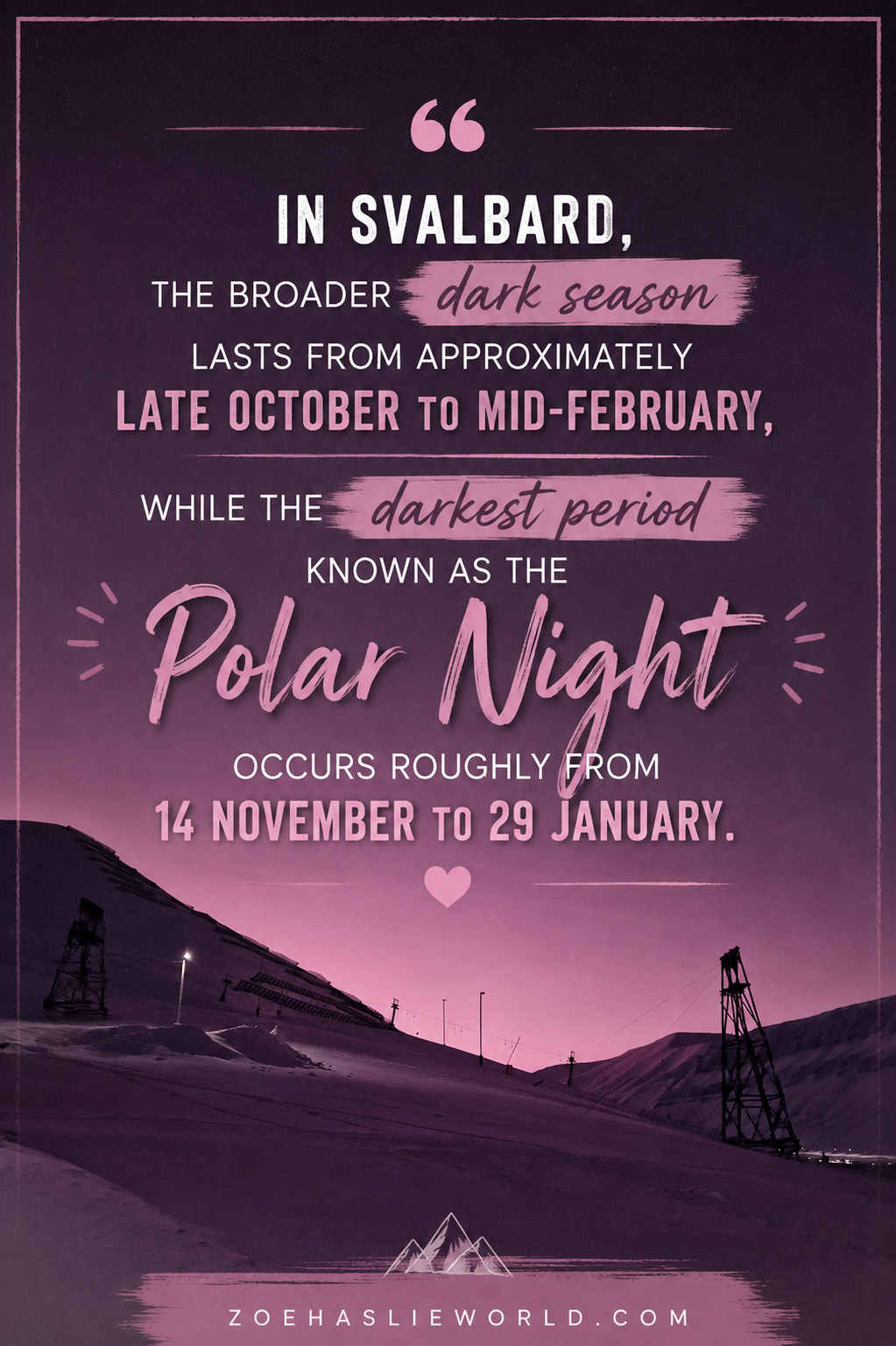
In Svalbard, the broader dark season lasts from approximately late October to mid-February, while the darkest period known as the Polar Night occurs roughly from 14 November to 29 January. Even during Polar Night, there can be a small amount of twilight around midday, so it isn't necessarily pitch-black every minute of the day.
That distinction is important. Because Svalbard's dark season and Polar Night are not exactly the same thing.
When Is Polar Night in Svalbard?
If you're planning a trip, knowing the dates is essential.
According to Visit Svalbard, the broader dark season runs from around 26 October to 16 February, when the sun remains below the horizon 24 hours a day. The darkest part, the Polar Night, lasts approximately from 14 November to 29 January.
The beginning and end of this period don't feel exactly the same.
Before and after the darkest part of winter, there is more noticeable twilight during the middle of the day. During the heart of Polar Night, the landscape can feel much darker, particularly when clouds and mountains block the faint light coming from below the horizon.
So if you're choosing when to visit Svalbard, don't simply think: October = dark and January = dark. The quality and amount of light change significantly throughout the season.
Svalbard Polar Night: 15 Fascinating Facts Nobody Tells You
1. The sun doesn't suddenly disappear
One of the biggest misconceptions about Polar Night is that you go from ordinary daylight to complete darkness overnight.
In reality, the transition happens gradually. As autumn progresses, the sun gets lower and lower in the sky. Eventually, it disappears below the horizon, but the landscape continues to receive varying amounts of twilight.
This gradual transition is one reason Svalbard's seasons feel so dramatic. The darkness slowly takes over. And then, months later, the light slowly returns.
2. Polar Night isn't completely pitch black all day
This is probably the most important thing to understand about Polar Night in Svalbard.
Although the sun doesn't rise, the sky isn't necessarily black from morning until evening. During the Polar Night, Svalbard experiences what is known as Civil Polar Night. There can still be faint twilight around midday, with beautiful blue and reddish tones appearing on the horizon.
Mountains can make this effect less noticeable from Longyearbyen, however, which is why the darkest part of the season can still feel like continuous nighttime.
3. The blue light can last for hours
Instead of a traditional sunrise and sunset, the Arctic winter can offer long periods of soft twilight. The landscape may take on deep blue, purple, and reddish tones, particularly around midday.
This is one of the reasons photographers love Svalbard during the darker months. Snow-covered mountains, glaciers, and buildings can look completely different under this low Arctic light compared with the bright conditions of summer.
If you're visiting during Polar Night, don't assume that there is simply “nothing to see” during the day. The light itself becomes part of the experience.
Svalbard Wildlife: Bold & Easy Coloring Book (Printable PDF)

Discover the Arctic with 50+ bold and easy coloring pages featuring adorable Svalbard wildlife, fun facts, and relaxing illustrations for all ages. Inspired in my Ultimate Svalbard Travel Guide
4. Svalbard has a much longer dark season than you might expect
Svalbard's dark season lasts for roughly 113 days, from late October until mid-February. That's considerably longer than many people imagine when they hear the words “Arctic winter.”
The reason is simple: Svalbard lies much farther north than mainland Norway. And the closer you get to the North Pole, the longer the seasonal periods of darkness and continuous daylight become.
5. You can see the Northern Lights during the day
This sounds impossible until you remember that the sun isn't rising.
During the Polar Night, the sky can be dark enough for the Northern Lights to potentially be visible even during the middle of the day. Of course, seeing the aurora is never guaranteed, as you need suitable solar activity, clear enough skies, darkness, and a little luck.
But Svalbard's Polar Night gives you an unusual advantage: there are many more hours of darkness in which the Northern Lights could potentially appear.
6. You might need a headlamp just to walk around town
When the darkest part of the season arrives, artificial light becomes part of everyday life.
A headlamp or flashlight is an incredibly useful item to pack for Svalbard during Polar Night.
Even around Longyearbyen, where streets are illuminated, you'll want good visibility when moving around in the dark. It is also recommended wearing a reflector or high-visibility vest during the dark season (especially if you have a dark winter jacket). If you're planning your trip, this is one item I'd put on your Svalbard packing list.
Related articles:
❄️ What to Pack for Svalbard: The Ultimate Arctic Packing List
🌌 The Best Travel Accessories for Svalbard: 15 Essentials You Shouldn’t Leave Home Without
7. Longyearbyen doesn't shut down
You might imagine that a place experiencing months of darkness would become almost completely inactive. Well, quite the opposite.
Longyearbyen remains a lively community throughout the dark season. Residents still work, meet friends, go to restaurants and cafés, attend cultural events, concerts, and Christmas markets, exercise, and spend time outdoors.
The darkness becomes part of everyday life rather than something that brings life to a halt.
8. Polar Night can be surprisingly social
There's something interesting about living through such an unusual natural phenomenon together. As a result, the darker months encourage people to gather indoors, enjoy good food, attend events, and spend time with friends.
Longyearbyen even hosts events and festivals during the dark season, including Dark Season Blues in late October.
So while the landscape may be dark, the town certainly isn't lifeless.
9. Winter activities don't stop because the sun is gone
The lack of daylight doesn't mean you have to stay indoors. Depending on the season, weather, snow conditions, and tour availability, visitors can experience activities such as:
🌌 Dog sledding
❄️ Guided hikes
❄️ Winter photography
🌌 Glacier and ice-cave experiences
❄️ Guided Arctic wilderness expeditions
10. You shouldn't explore the wilderness alone
This is one of the most important practical facts about visiting Svalbard. The darkness isn't the only challenge. Polar bears live throughout the Svalbard archipelago, and the wilderness needs to be treated with respect.
If you're leaving Longyearbyen, don't simply wander off into the surrounding landscape by yourself. For visitors, organized tours with experienced local guides are one of the safest and easiest ways to explore the Arctic environment.
11. The landscape looks completely different in winter
Svalbard in summer is famous for bright skies, colorful tundra, glaciers, and the Midnight Sun.
Polar Night offers an entirely different visual experience. Mountains become silhouettes. Snow reflects faint ambient light. The sky can shift between deep blue and black. Artificial lights from Longyearbyen create small pools of warmth against the surrounding darkness.
And when the Northern Lights appear, the landscape can suddenly be illuminated by green or other colors dancing across the sky. It's almost like seeing two completely different destinations.
12. The cold and darkness are two separate things to prepare for
When packing for Svalbard in winter, most people immediately think about staying warm. That's obviously important. But visibility is another consideration.
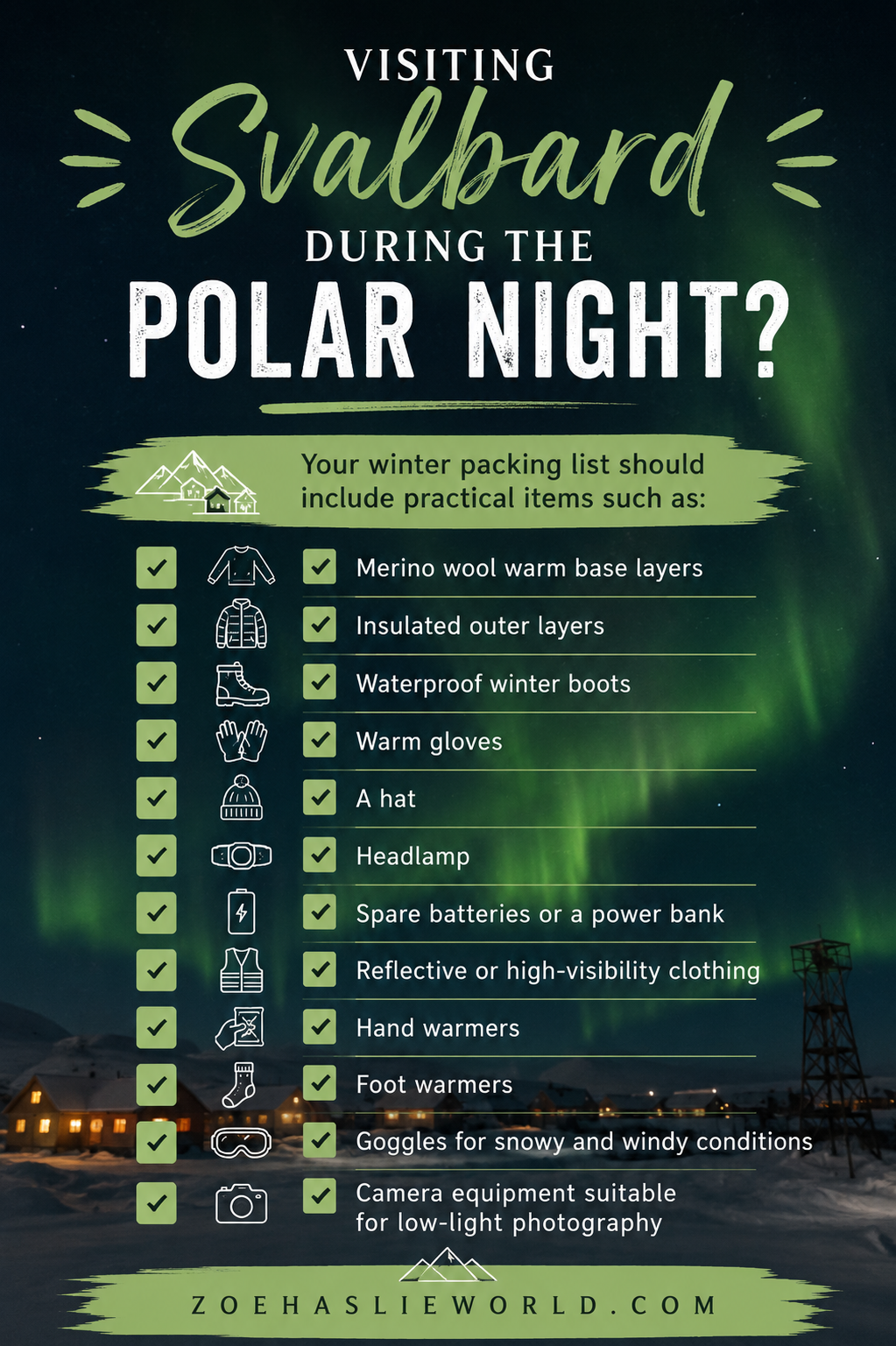
Your winter packing list should include practical items such as:
- Merino wool warm base layers
- Insulated outer layers
- Waterproof winter boots
- Warm gloves
- A hat
- Headlamp
- Spare batteries or a power bank
- Reflective or high-visibility clothing
- Hand warmers
- Foot warmers
- Goggles for snowy and windy conditions
- Camera equipment suitable for low-light photography
The exact clothing you need depends on the season and activities you plan to do.
For more practical advice, check out my article What to Pack for Svalbard: The Ultimate Arctic Packing List.
13. The weather can change quickly
Svalbard is an Arctic environment, and conditions can change rapidly. Cold temperatures, wind, snow, and changing visibility can affect outdoor activities and travel plans. That's another reason guided activities are so useful.
Local guides know the area and can adapt plans according to the conditions. When planning your itinerary, leave some flexibility rather than assuming that every outdoor activity will happen exactly as scheduled.
Related article:
5 Days in Svalbard: The Perfect Arctic Itinerary (Regardless of When You Visit)
14. The return of the sun is a big deal
After weeks of darkness, the return of the sun can feel extraordinary. As January progresses toward February, the amount of light increases. Eventually, sunlight once again reaches Longyearbyen.
For locals, the return of the sun is an important annual event and a reminder that the season is changing. The darkness slowly gives way to the brighter part of winter, bringing with it a completely different atmosphere.
And if you've spent weeks in Polar Night, seeing those first rays of sunlight can feel much more meaningful than you might expect.
15. Polar Night changes your entire experience of Svalbard
Perhaps the most fascinating fact of all is that Svalbard during Polar Night feels like a completely different destination from Svalbard in summer. During the Midnight Sun, you can hike beneath bright skies at midnight. During Polar Night, you may walk beneath a star-filled sky in the middle of the day.
Summer feels expansive and bright. Winter feels quiet, mysterious, and atmospheric. Neither is necessarily better. They're simply completely different ways to experience the Arctic.
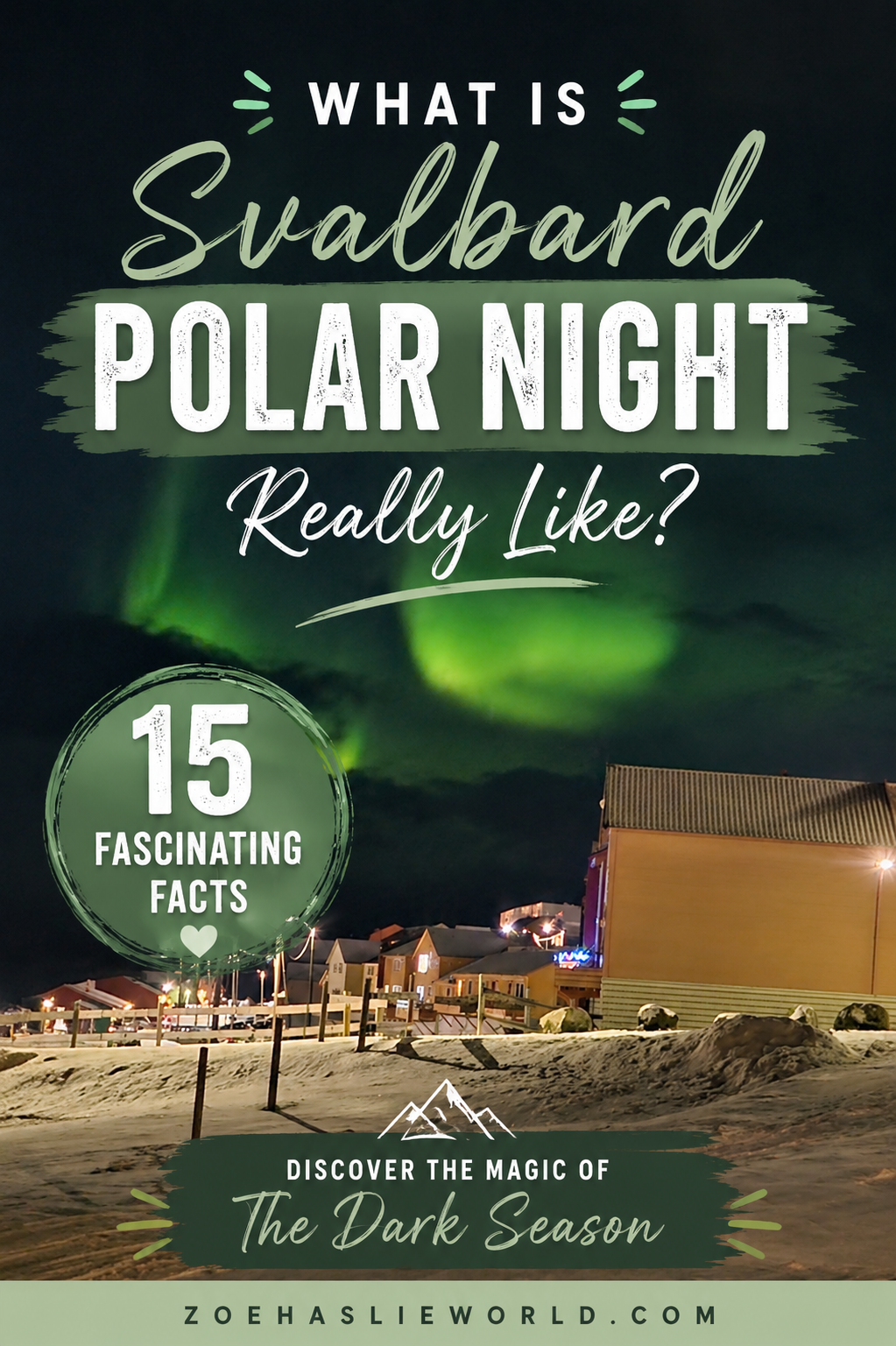
What Is It Really Like to Visit Svalbard During Polar Night?
The first thing that may surprise you is how quickly your normal sense of time disappears. You wake up. It's dark. You eat breakfast. It's still dark. You head out for an activity. Still dark.
Then, somewhere around the middle of the day, the sky may brighten into an incredible shade of deep blue before gradually becoming dark again.
Eventually, you stop expecting the sun to tell you what time it is. Instead, you start paying attention to the weather, the sky, your activities, and the rhythm of the day. And strangely enough, that can become part of the charm.
Is Svalbard Worth Visiting During Polar Night?
If you're looking for a conventional winter holiday with lots of daylight, probably not. But if you're looking for an unusual Arctic adventure, Svalbard during Polar Night is difficult to beat.
You can experience:
- Extended Arctic twilight
- Northern Lights opportunities
- Dog sledding
- Snowmobile adventures
- Snow-covered landscapes
- Arctic wildlife
- Incredible winter photography
- Cozy cafés and restaurants in Longyearbyen
- A truly unique seasonal experience
The important thing is to visit with realistic expectations. You're traveling to one of the world's most extreme inhabited environments, so weather, darkness, and activity conditions can all affect your plans. But that's also part of what makes Svalbard so special.
Svalbard Polar Night FAQs
How long is Polar Night in Svalbard?
The Polar Night in Svalbard lasts approximately from 14 November to 29 January. The broader dark season lasts roughly from late October to mid-February.
Is Svalbard completely dark during Polar Night?
Not quite. Although the sun doesn't rise, Svalbard experiences Civil Polar Night, meaning there can still be some twilight around midday. The amount of visible light varies throughout the season and can also be affected by mountains, clouds, and weather.
Can you see the Northern Lights during Polar Night?
Yes. One of the fascinating things about Svalbard is that the Northern Lights can potentially be visible even during the middle of the day during Polar Night because the sky remains dark enough. However, aurora sightings are never guaranteed. And due to the far north location, they are a way less intense phenomenon than in other destinations (such as Iceland, Finish Lapland, Lofoten or Tromsø).
Is Svalbard worth visiting in winter?
Absolutely, if you're prepared for the conditions. Winter offers unique experiences that you can't have during the Midnight Sun, including Polar Night, Northern Lights opportunities, dog sledding, snowmobiling, and a completely different Arctic landscape.
What should I pack for Svalbard during Polar Night?
Warm, wind-resistant clothing is essential, but don't forget a headlamp, spare batteries or a power bank, and reflective or high-visibility clothing. Good footwear and several warm layers are also important.
For a more detailed checklist, see my post What to Pack for Svalbard: The Ultimate Arctic Packing List.
Can you do outdoor activities during Polar Night?
Yes. A variety of guided activities operate during the dark season, including Northern Lights experiences, dog sledding, snowmobile excursions, and other winter adventures. Availability depends on the time of year, weather, snow conditions, and individual tour operators.
Is it safe to visit Svalbard during Polar Night?
Visitors can safely enjoy Svalbard during Polar Night when they prepare properly and follow local safety advice.
The wilderness is remote and potentially dangerous, particularly because of polar bears and rapidly changing Arctic conditions. When leaving Longyearbyen, visitors should follow local guidance and use experienced guides for wilderness activities.
More Svalbard Travel Guides
Planning your own Arctic adventure? Start with these guides:
❄️ 23 Essential Things You Need to Know Before Traveling to Svalbard
🧳 What to Pack for Svalbard: The Ultimate Arctic Packing List
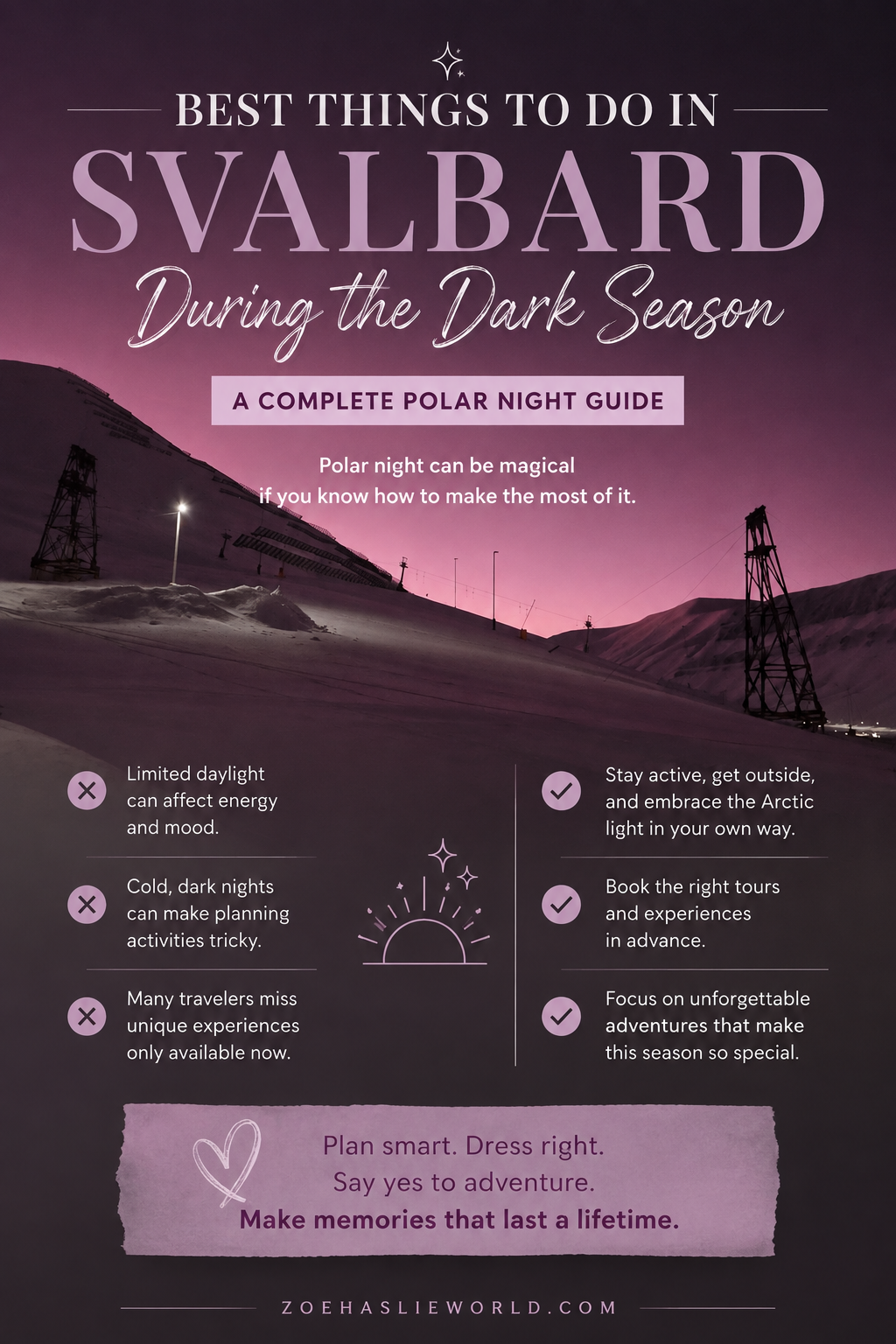
🌙Best Things to Do in Svalbard During the Dark Season: A Complete Polar Night Guide
🗺️ 5 Days in Svalbard: The Perfect Arctic Itinerary
💰 13 Budget-Friendly Svalbard Travel Tips for First-Time Visitors
🎒 The Best Travel Accessories for Svalbard: 15 Essentials You Shouldn't Leave Home Without
Final Thoughts -Svalbard Polar Night: 15 Fascinating Facts Nobody Tells You
There's something incredibly humbling about experiencing a place where the natural world determines the rhythm of everyday life.
Svalbard's Polar Night isn't simply a period without sunshine. It's a season of deep darkness, blue twilight, star-filled skies, Arctic adventures, cozy evenings, and the possibility of seeing the Northern Lights when you'd least expect them.
For a few months each year, Svalbard becomes a place where darkness isn't something to escape. All the opposite. It's something to experience.
And perhaps that's the most fascinating thing about Polar Night: once you stop waiting for the sun to return, you start noticing just how much beauty there is in the dark.
If You Enjoyed This Svalbard Post, Check Out...

About Me
📍Dumbo - New York
I'm Zøe!
I write heartfelt, character-driven fiction featuring resilient teenage heroines navigating personal challenges and striving to become their best selves. Beyond my novels, I love storytelling in all its forms. On this blog, I share narrative-rich travel pieces, offering glimpses into my favorite places, hidden corners, and unforgettable encounters around the globe.
Join My Newsletter!
Get book lists, reading inspiration, travel guides, and wanderlust YA recommendations.

Some of the links on this site are affiliate links. This means that if you click on a link and make a purchase, I may earn a small commission at no extra cost to you. I only recommend books and products that I genuinely love and think you’ll enjoy.